

Exam Information
Duration: 20-30 minutes
Format: Face-to-face or computer-based
Pass Score: 60% overall
Language Level: A2 (Basic Independent User)
Exam Structure
- Part 1: Personal Questions (6 questions)
- Part 2: Picture Description (2 pictures)
- Part 3: Role-Play Situations (5 scenarios)
PART 1: PERSONAL QUESTIONS (6 questions)
The examiner will ask you questions about yourself. Answer in complete sentences.
Question 1: Personal Information
Examiner: “Vertel iets over jezelf. Hoe heet je, waar woon je, en wat doe je?”
What to include:
- Your name
- Where you live (city/neighborhood)
- Your occupation or daily activities
- Maybe: where you’re from originally
Example answer: “Ik heet Ahmed en ik woon in Utrecht, in de wijk Lombok. Ik kom uit Syrië. Op dit moment volg ik een Nederlandse cursus en ik zoek werk als kok. Ik woon hier met mijn vrouw en twee kinderen.”
Question 2: Housing
Examiner: “Waar woon je? Beschrijf je huis of appartement.”
What to include:
- Type of home (huis/appartement/studio)
- Number of rooms
- What you like/don’t like about it
- Location (centrum/quiet/busy area)
Example answer: “Ik woon in een appartement op de derde verdieping. Het heeft twee slaapkamers, een woonkamer, een keuken en een badkamer. Het appartement is klein maar gezellig. Ik vind de locatie goed omdat de supermarkt dichtbij is. Maar er is geen lift, dus de trap is soms vermoeiend.”
Question 3: Daily Routine
Examiner: “Wat doe je op een gewone dag? Vertel over je dagindeling.”
What to include:
- Morning activities
- Afternoon/daytime
- Evening
- Use time expressions
Example answer: “Op een gewone dag sta ik om 7 uur op. Eerst ontbijt ik en dan breng ik mijn kinderen naar school. Daarna ga ik naar mijn Nederlandse les van 9 tot 12 uur. ‘s Middags doe ik boodschappen of huishoudelijk werk. Om 3 uur haal ik de kinderen op. ‘s Avonds koken we samen en om 10 uur ga ik slapen.”
Question 4: Free Time
Examiner: “Wat doe je graag in je vrije tijd? Wat zijn je hobby’s?”
What to include:
- Activities you enjoy
- How often you do them
- With whom (alone/friends/family)
- Why you like them
Example answer: “In mijn vrije tijd lees ik graag boeken en ik sport. Elke zaterdag speel ik voetbal met vrienden in het park. Ik vind dit leuk omdat ik nieuwe mensen ontmoet en het is goed voor mijn gezondheid. Ook kijk ik soms naar Nederlandse series op Netflix om mijn Nederlands te oefenen.”
Question 5: Future Plans
Examiner: “Wat zijn je plannen voor de toekomst? Wat wil je bereiken?”
What to include:
- Work goals
- Language learning goals
- Family plans
- Integration goals
Example answer: “Mijn belangrijkste plan is om mijn inburgeringsexamen te halen. Daarna wil ik graag werk vinden in een restaurant als kok, want dat is mijn beroep. Ik wil ook beter Nederlands leren, misschien tot B1-niveau. Voor mijn kinderen wil ik dat ze goed integreren in Nederland en goede opleidingen volgen.”
Question 6: Past Experience
Examiner: “Vertel over een leuke ervaring die je in Nederland hebt gehad.”
What to include:
- When it happened
- Where you were
- What you did
- Why it was nice/special
Example answer: “Vorige maand ben ik met mijn gezin naar Giethoorn geweest. Dat is een mooi dorp zonder auto’s, alleen boten en bruggen. We hebben een boottochtje gemaakt en het was heel rustig en mooi. De kinderen vonden het fantastisch. Het was een leuke kennismaking met de Nederlandse cultuur. We hebben veel foto’s gemaakt.”
PART 2: PICTURE DESCRIPTION (2 pictures)
You will see a picture and must describe what you see. Talk for about 1-2 minutes per picture.
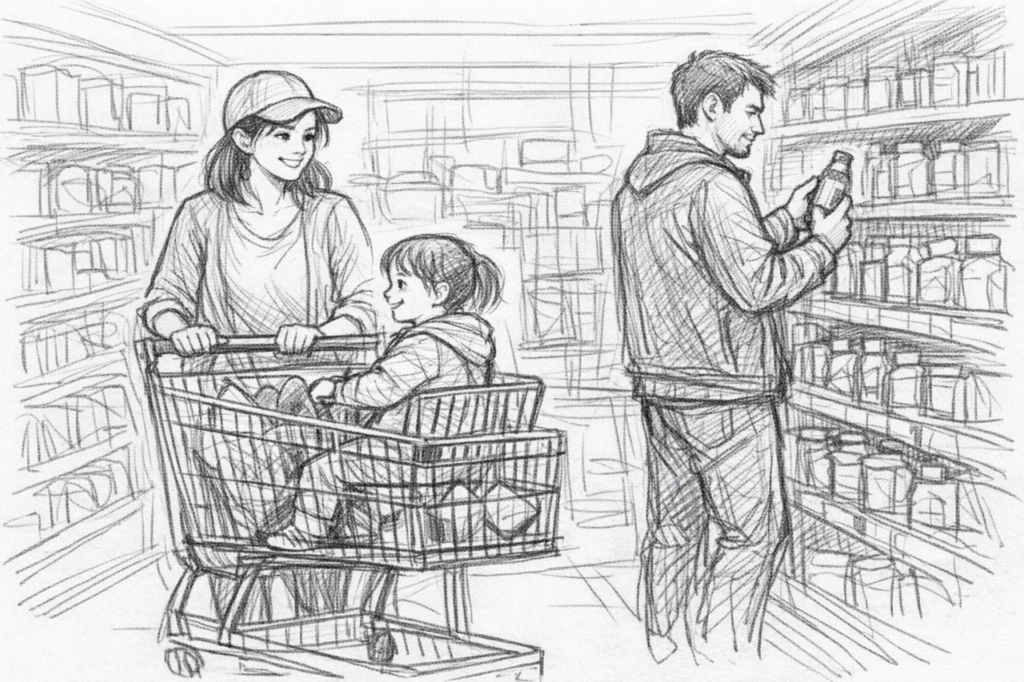
Picture 1: SUPERMARKET SCENE
What to say:
Opening: “Op deze foto zie ik een gezin in een supermarkt.”
Details – Who: “Er is een moeder, een vader en een kind. Het kind zit in het winkelwagentje.”
Details – What are they doing: “De moeder duwt het wagentje. De vader kijkt naar producten op de plank. Misschien zoekt hij iets om te kopen. Het kind kijkt om zich heen.”
Details – Location: “Ze zijn in de supermarkt, bij de afdeling met eten. Ik zie schappen met veel producten.”
Your opinion/experience: “Ik denk dat dit een normale zaterdag is. Veel gezinnen gaan samen boodschappen doen in het weekend. Ik doe dit ook vaak met mijn familie. Boodschappen doen met kinderen is soms moeilijk omdat kinderen altijd snoep willen!”
Useful phrases for pictures:
- Op deze foto zie ik… (In this picture I see…)
- Er is/zijn… (There is/are…)
- Links/rechts/in het midden zie ik… (On the left/right/in the middle I see…)
- De man/vrouw/het kind… (The man/woman/child…)
- Ze dragen… (They’re wearing…)
- Ik denk dat… (I think that…)
- Het lijkt… (It seems…)
- Misschien… (Maybe…)
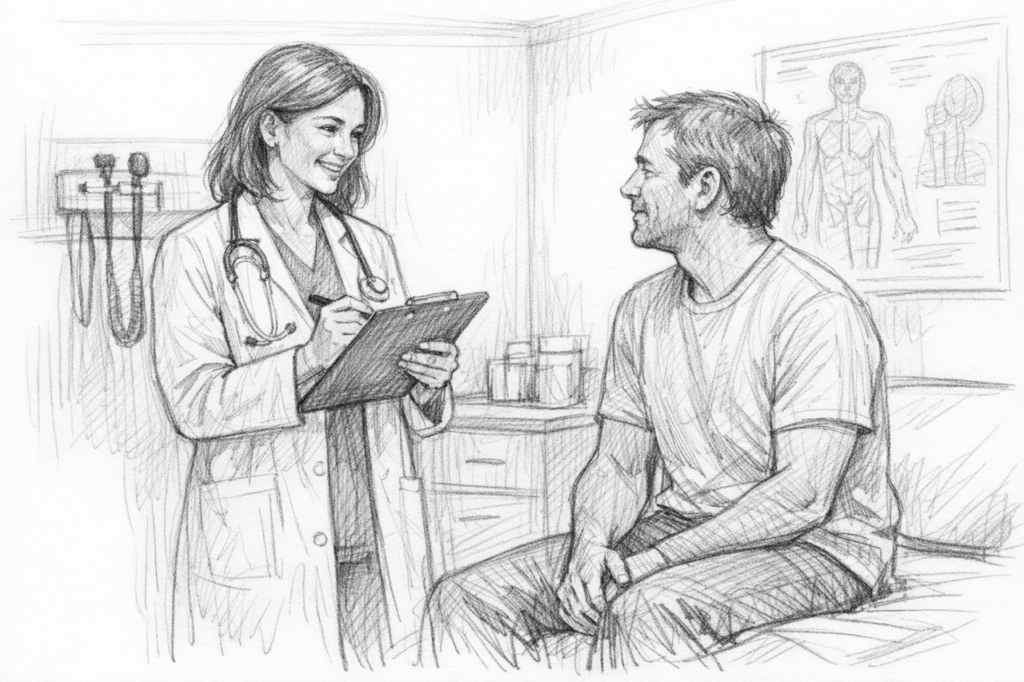
Picture 2: DOCTOR’S OFFICE
What to say:
Opening: “Deze foto is in een doktersspreekkamer.”
Details – Who: “Ik zie een dokter en een patiënt. De dokter is een vrouw met een witte jas. De patiënt is een man.”
Details – What: “De man zit op een stoel. De dokter staat en ze heeft een klembord in haar hand. Ze praten met elkaar. Misschien vraagt de dokter over de gezondheid van de man, of ze geeft advies.”
Details – Setting: “Op de achtergrond zie ik medische apparatuur en een bureau. Het is een gewone doktersspreekkamer.”
Your opinion/experience: “Ik denk dat de man misschien ziek is of een controle heeft. In Nederland maak je eerst een afspraak bij de huisarts. Ik ben ook al naar de dokter geweest in Nederland. De dokters hier zijn vriendelijk en nemen de tijd voor je.”
PART 3: ROLE-PLAY SITUATIONS (5 scenarios)
You will have a conversation with the examiner. They will give you a situation and you must respond appropriately.
Situation 1: AT THE PHARMACY
Scenario: Je bent bij de apotheek. Je hebt last van hoofdpijn en wilt medicijnen kopen.
Examiner (as pharmacist): “Goedemiddag, kan ik u helpen?”
Your response should include:
- Greeting
- Explain your problem (headache)
- Ask for medicine
- Ask about price/how to use
Example dialogue:
You: “Goedemiddag. Ik heb last van hoofdpijn. Heeft u iets daarvoor?”
Examiner: “Ja, we hebben paracetamol. Dat kost €3,50.”
You: “Oké, dat is goed. Hoe moet ik het innemen?”
Examiner: “Eén tablet per keer, maximaal 4 per dag. Met water.”
You: “Prima. Ik neem het. Kan ik pinnen?”
Examiner: “Ja natuurlijk. Dat is €3,50 alstublieft.”
You: “Alstublieft. Dank u wel.”
Examiner: “Graag gedaan. Beterschap!”
You: “Dank u wel. Tot ziens.”
Situation 2: MAKING A DOCTOR’S APPOINTMENT
Scenario: Je belt naar de huisartsenpraktijk. Je wilt een afspraak maken omdat je ziek bent.
Examiner (as receptionist): “Huisartsenpraktijk Jansen, goedemorgen.”
Your response should include:
- Greeting and introduce yourself
- Say why you’re calling
- Explain your health problem
- Agree on appointment time
Example dialogue:
You: “Goedemorgen. Met Anna Kowalski. Ik wil graag een afspraak maken.”
Examiner: “Wat zijn uw klachten?”
You: “Ik heb al drie dagen keelpijn en koorts. Ik voel me niet goed.”
Examiner: “Dat klinkt niet fijn. Kunt u morgen om 10 uur komen?”
You: “Ja, morgen om 10 uur is goed. Bij dokter Jansen?”
Examiner: “Ja, klopt. Heeft u uw zorgverzekeringspas bij u?”
You: “Ja, die neem ik mee.”
Examiner: “Prima. Tot morgen dan.”
You: “Dank u wel. Tot morgen. Dag.”
Situation 3: AT THE TRAIN STATION
Scenario: Je bent op het station. Je wilt een kaartje kopen naar Amsterdam, maar je begrijpt het kaartautomaat niet. Je vraagt hulp aan een medewerker.
Your response should include:
- Politely ask for help
- Say where you want to go
- Ask about price
- Ask about train times
Example dialogue:
You: “Excuseer, kunt u mij helpen? Ik begrijp deze automaat niet.”
Examiner (as station employee): “Natuurlijk. Waar wilt u naartoe?”
You: “Naar Amsterdam Centraal. Hoeveel kost een kaartje?”
Examiner: “Enkele reis of retour?”
You: “Retour graag.”
Examiner: “Dat is €15,80. Wanneer wilt u reizen?”
You: “Nu meteen. Hoe laat gaat de volgende trein?”
Examiner: “Om 14:35, vanaf spoor 3.”
You: “Oké, dank u wel voor uw hulp!”
Examiner: “Graag gedaan. Goede reis!”
You: “Dank u. Dag.”
Situation 4: RENTING AN APARTMENT
Scenario: Je belt naar een makelaar over een appartement dat te huur is. Je wilt meer informatie.
Your response should include:
- Introduce yourself
- Say you’re interested in the apartment
- Ask about: price, size, when available, if you can visit
Example dialogue:
You: “Goedemiddag, met Maria Santos. Ik bel over het appartement op Hoofdstraat 45.”
Examiner (as real estate agent): “Ja, dat is nog beschikbaar. Wat wilt u weten?”
You: “Hoeveel kamers heeft het?”
Examiner: “Twee slaapkamers, een woonkamer, keuken en badkamer.”
You: “En wat is de huurprijs per maand?”
Examiner: “€950 per maand, exclusief gas, water en licht.”
You: “Wanneer is het beschikbaar?”
Examiner: “Vanaf 1 april.”
You: “Kan ik het appartement bezichtigen?”
Examiner: “Ja natuurlijk. Wanneer kunt u?”
You: “Is morgen mogelijk?”
Examiner: “Ja, om 15 uur?”
You: “Perfect. Dank u wel. Tot morgen.”
Situation 5: AT THE SCHOOL (Parent-Teacher)
Scenario: Je bent bij school voor een gesprek met de leraar van je kind. De leraar vertelt dat je kind het goed doet, maar moet meer huiswerk maken.
Your response should include:
- Thank the teacher
- Ask questions about your child
- Say you will help at home
- Ask what you can do
Example dialogue:
Examiner (as teacher): “Goedemiddag mevrouw/meneer. Bedankt dat u komt. Uw dochter doet het goed op school.”
You: “Dat is fijn om te horen! Hoe gaat het met Nederlands?”
Examiner: “Het gaat beter. Maar ze moet thuis meer oefenen met lezen.”
You: “Oké, ik begrijp het. Hoeveel huiswerk moet ze per dag maken?”
Examiner: “Ongeveer 30 minuten per dag. Vooral lezen is belangrijk.”
You: “Goed, ik zal haar thuis helpen. Kan ik extra materiaal krijgen?”
Examiner: “Ja, ik geef u een lijst met geschikte boeken.”
You: “Dank u wel. Als er problemen zijn, kunt u mij bellen?”
Examiner: “Natuurlijk. Heeft u nog vragen?”
You: “Nee, dank u voor het gesprek. Tot ziens.”
EVALUATION CRITERIA
You will be scored on:
1. Fluency (Vloeiendheid) – 25%
- Can you speak without too many long pauses?
- Is your speech reasonably smooth?
- ✓ Small pauses are okay!
- ✓ Saying “ehm” or “nou” is normal
2. Grammar & Sentence Structure (Grammatica) – 25%
- Do you use correct word order?
- Are verb conjugations mostly correct?
- Are sentences complete?
- ✓ Small mistakes are okay if meaning is clear
3. Vocabulary (Woordenschat) – 25%
- Do you use appropriate words?
- Can you describe situations clearly?
- Do you use variety in vocabulary?
- ✓ You can explain if you don’t know a word
4. Pronunciation (Uitspraak) – 25%
- Can the examiner understand you?
- Are the most important sounds correct?
- ✓ Accent is okay – clarity matters!
Tips for Speaking Success
Before You Speak:
- Take a breath – Don’t rush
- Think for 2-3 seconds – Organize your thoughts
- Start confidently – Even if nervous inside
While Speaking:
- Speak clearly – Not too fast
- Use hand gestures – Helps communication
- Make eye contact – Shows confidence
- Don’t worry about small mistakes – Keep going!
If You Don’t Understand:
- “Kunt u dat herhalen?” (Can you repeat that?)
- “Kunt u langzamer spreken?” (Can you speak slower?)
- “Wat betekent…?” (What does… mean?)
- “Ik begrijp het niet helemaal.” (I don’t fully understand.)
If You Don’t Know a Word:
- Describe it: “Het is een ding voor…” (It’s a thing for…)
- Use similar words: “Het is zoals…” (It’s like…)
- Give example: “Bijvoorbeeld…” (For example…)
- Ask: “Hoe zeg je… in het Nederlands?” (How do you say… in Dutch?)
Time Fillers (Buy Time to Think):
- “Ehm…” or “Nou…”
- “Laat me denken…” (Let me think…)
- “Hoe zeg ik dat…” (How do I say that…)
- “Dat is een goede vraag…” (That’s a good question…)
Common Sentence Starters:
- “Ik denk dat…” (I think that…)
- “In mijn mening…” (In my opinion…)
- “Ik vind…” (I find/think…)
- “Het is belangrijk om…” (It’s important to…)
- “Meestal…” (Usually…)
Practice Exercises
Exercise 1: Daily Practice (5 minutes)
Talk out loud about:
- What you did today
- What you’re going to do tomorrow
- What you like/don’t like
Exercise 2: Picture Description
- Find any picture (photo, magazine, online)
- Describe it for 1-2 minutes
- Include: who, what, where, when, why
Exercise 3: Role-Play at Home
Practice these situations:
- Calling your doctor
- Shopping at the supermarket
- Asking for directions
- Making a complaint
- Introducing yourself
Exercise 4: Record Yourself
- Use your phone
- Record answers to practice questions
- Listen back – what can you improve?
- Do you speak clearly enough?
Exercise 5: Language Partner
- Find a Dutch conversation partner
- Use websites: Taalvrijwilliger.nl, Biblioth eek (taalhuizen)
- Practice speaking 30 minutes per week
Useful Vocabulary for Speaking Exam
Talking About Yourself:
- Ik kom uit… = I’m from…
- Ik woon in… = I live in…
- Ik werk als… = I work as…
- Ik ben getrouwd/alleenstaand = I’m married/single
- Ik heb … kinderen = I have … children
Expressing Opinion:
- Ik vind dat… = I think that…
- Naar mijn mening… = In my opinion…
- Ik ben het eens/oneens = I agree/disagree
- Dat is (niet) belangrijk = That is (not) important
Describing:
- Het is groot/klein = It’s big/small
- Het ligt in… = It’s located in…
- Er is/zijn… = There is/are…
- Ik zie… = I see…
Asking Questions:
- Hoe laat…? = What time…?
- Hoeveel kost…? = How much does… cost?
- Waar is…? = Where is…?
- Wanneer kan ik…? = When can I…?
Polite Phrases:
- Zou u…kunnen? = Could you…?
- Mag ik…? = May I…?
- Is het mogelijk om…? = Is it possible to…?
- Dank u wel/Dank je wel = Thank you
Final Reminders
✓ Don’t aim for perfection – Communication is the goal
✓ Small mistakes are okay – Examiners expect A2 level
✓ Speak clearly and slowly – Better than fast with mistakes
✓ Use what you know – Don’t try to be too complicated
✓ Stay calm – Nervousness is normal
✓ Listen carefully – Make sure you understand the question
✓ Practice OUT LOUD – Not just in your head!
Veel succes met je spreekexamen! (Good luck with your speaking exam!)
